North Merseyside Local Wildlife Site selection guidelines outline the rules by which Local Wildlife Sites in North Merseyside are selected. These rules include thresholds, some of which are tailored specifically to a taxonomic group.
Species that meet those thresholds are considered local conservation priorities ensuring that we maintain an evidence led approach to delivering local conservation action and decision taking.
Delivering ongoing evidence review and data collection the Lancashire & Cheshire Fauna Society have produced a new Atlas of Dragonflies “Dragonflies of Lancashire & North Merseyside” which can be purchased via the British Dragonfly Society.
The data and review of Odonata have led to the revision of the Local Wildlife Site selection guidelines on Odonata. The revised guidelines can be downloaded here.
8. ODONATA
These guidelines and site selection have been based upon the dragonfly atlas (White, SJ & Smith PH. 2015. The Dragonflies of Lancashire and North Merseyside. Lancashire & Cheshire Fauna Society.)
Od1 Any site which regularly supports a breeding population of ten or more species of dragonfly or damselfly.
Od2 Any site which regularly supports a breeding population of a rare or scarce North Merseyside breeding species
8. ODONATA
These guidelines and site selection have been based upon the dragonfly atlas (White, SJ & Smith PH. 2015. The Dragonflies of Lancashire and North Merseyside. Lancashire & Cheshire Fauna Society.)
Od1 Any site which regularly supports a breeding population of ten or more species of dragonfly or damselfly.
Application:
8.1 For the purpose of this guideline acceptable evidence of breeding by dragonfly and damselfly species includes identification of larvae or exuvia; or a female seen ovipositing, mating pairs or the occurrence of regular populations of adults in suitable habitat.
Justification:
18 species have bred annually in North Merseyside in recent years. Ten species represents a notable local breeding assemblage. The following species are relevant for the purposes of this guideline:
Table A. Damselfly and Dragonfly Assemblage Species
Aeshna cyanea – Southern Hawker
Aeshna grandis – Brown Hawker
Aeshna juncea – Common Hawker
Aeshna mixta – Migrant Hawker
Anax imperator – Emperor Dragonfly
Calopteryx splendens – Banded Demoiselle
Coenagrion puella – Azure Damselfly
Enallagma cyathigerum – Common Blue Damselfly
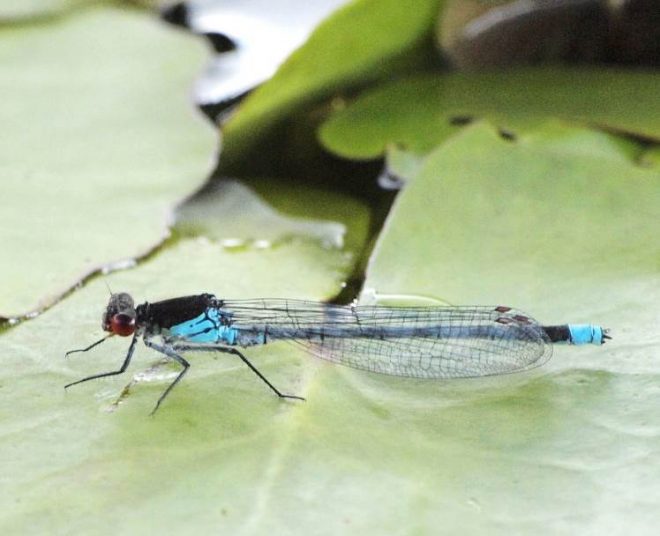
Erythromma najas – Red-eyed Damselfly
Ischnura elegans – Blue-tailed Damselfly
Lestes sponsa – Emerald Damselfly
Libellula depressa – Broad-bodied Chaser
Libellula quadrimaculata – Four-spotted Chaser
Orthetrum cancellatum – Black-tailed Skimmer
Pyrrhosoma nymphula – Large Red Damselfly
Sympetrum danae – Black Darter
Sympetrum sanguineum – Ruddy Darter
Sympetrum striolatum – Common Darter
Od2 Any site which regularly supports a breeding population of a rare or scarce North Merseyside breeding species
Application:
Rare breeding dragonflies and damselflies are those which occur in a single tetrad (2 x 2 km square of the National Grid) in North Merseyside, scarce species occur in two to six tetrads. The species to which this guideline may be applied in North Merseyside include: Red-eyed Damselfly Erythromma najas, Common Hawker Aeshna juncea, Black Darter Sympetrum danae, and Ruddy Darter Sympetrum sanguineum.
Justification:
8.3.1 These species have been selected according to Biodiversity Action Plan guidelines. All are rare in North Merseyside or are restricted to a very few local sites: some are on the edge of their range locally while others are rare in North Merseyside because of a lack of suitable habitat.
Reviewed by: Steve White, British Dragonfly Society Recorder for Vice Counties 59 & 60.
Review Date: July 2016
The Sefton Coast sand-dune system is considered to be nationally important for this group of insects with 11 breeding species.
Another regionally important locality is Colliers (Bold) Moss, St Helens with 17 species recorded in recent years, 14 of them regularly breeding.
Red-eyed Damselfly breeds at only one locality, Eccleston Dams in St Helens.
North Merseyside Biodiversity Action Plan
Dragonflies
1 Current status
1.1 National
Twenty-one species of dragonflies have been reliably recorded in North Merseyside. Three of these are rare vagrants from the continent or species that are beginning to colonise southern England. The others are relatively common nationally, though six are largely confined to southern and eastern England and have been extending their range north and west in recent years. Eight species, including the three vagrants, have only been recorded here since 1989.
1.2 Local
Eighteen of the 21 species have certainly bred in the region (Table 1). Six species, namely Red-eyed Damselfly Erythromma najas, Broad-bodied Chaser Libellula depressa, Black-tailed Skimmer Orthetrum cancellatum Common Hawker Aeshna juncea, Ruddy Darter Sympetrum sanguineum and Black Darter Sympetrum danae, have highly restricted breeding distributions in North Merseyside.
Table 1. Dragonflies and damselflies reliably recorded in North Merseyside.
Anisoptera
Emperor dragonfly Anax imperator B
Lesser Emperor Anax parthenope V
Southern Hawker Aeshna cyanea LB
Common Hawker Aeshna juncea RB
Brown Hawker Aeshna grandis B
Migrant Hawker Aeshna mixta LB
Broad-bodied Chaser Libellula depressa LB
Four-spotted Chaser Libellula quadrimaculata LB
Black-tailed Skimmer Orthetrum cancellatum LB
Common Darter Sympetrum striolatum B
Ruddy Darter Sympetrum. sanguineum RB
Black Darter Sympetrum. danae RB
Yellow-winged Darter Sympetrum flaveolum V
Red-veined Darter Sympetrum fonscolombii V
Zygoptera
Blue-tailed damselfly Ischnura elegans B
Emerald damselfly Lestes sponsa LB
Azure damselfly Coenagrion puella B
Common Blue damselfly Enallagma cyathigerum B
Large Red damselfly Pyrrhosoma nymphula LB
Red-eyed damselfly Erythromma najas RB
Banded Demoiselle Calopteryx splendens LB
B = widespread breeder ; LB = local breeder; RB = rare breeder; V = vagrant
The Sefton Coast sand-dune system is considered to be nationally important for this group of insects with 11 breeding species.
Another regionally important locality is Colliers (Bold) Moss, St Helens with 17 species recorded in recent years, 14 of them regularly breeding.
Red-eyed Damselfly breeds at only one locality, Eccleston Dams in St Helens.


